Redbank Valley Trails Association
History of the RVTA
How RVTA began
Redbank Valley Trails Association (RVTA) was officially organized by volunteers on May 17, 2010. The corridor was rail banked and acquired in June 2010 by the Allegheny Valley Land Trust (AVLT). Rail banking is done under a federal statute which preserves the corridor for possible return of the railroad, subjects it to certain railroad requirements and allows interim trail use. RVTA worked for almost 10 years with AVLT to improve the corridor for interim trail use. The corridor was conveyed to RVTA in February 2020.
Planning the trail
A Feasibility Study was completed in June 2011 on the main 41.5 mile trail funded by a grant from the Northwest Regional Planning Commission and sponsored by New Bethlehem Borough. RVTA Trail Feasibility Report 06242011
Volunteer-built progress
The first goals of the organization were to clean litter, clear brush, open drainage, and begin establishing the long term plan of developing the trail. Since that time, RVTA and a group of dedicated volunteers have made truly record progress. In 9 years, all of the main trail was graded and rolled to compact the ballast stone, all of it has been surfaced with crushed limestone for a smooth surface, parking areas have been established, and all of the bridges on the main trail have been decked and railed with most work done by volunteers. Work was completed in August 2019 on surfacing of the entire 9-mile Sligo Spur which connects to the main trail at Lawsonham (mile 6) through to Walker Farm Road a mile south of Sligo. On the Sligo Spur, a major washout was repaired within the first mile, 3 bridges were decked and railed, parking areas have been improved and gates were installed to keep motorized traffic off the spur for the safety of trail users.
Opening the tunnels
Our major hurdles were 2 of the 3 tunnels (Brookville and Climax) that needed drainage and roof work before the 2 tunnels could be opened. The Climax Tunnel at mile 17 was our highest priority because of its location near the middle of the trail. Phase 1 repaired a roof fall near the western portal. Phases 2, 3 and 4 added tunnel liners in from each portal to support the deteriorated 4-course spring arch brick lined ceiling and a buttress was added to the western portal with funding from DCNR and TAP/TE funding. Additional support and guniting was done in late 2017. In early 2018, an 80 foot extension from the eastern portal was added and the tunnel was completed in August 2018 and is now open. There are no current plans to improve the longer Brookville Tunnel at the current end of the trail since access is available via the Depot Street Spur. If the PA Wilds Loop and a connection to Brockway is completed by other groups, tunnel rehabilitation will be considered.
Kayak access
A kayak launch was added at Moore Road near mile 36 in 2015, a launch was added in Brookville on White Street across from the Depot Street Spur in July 2019, and a 2nd launch at the upstream end of the Moore Road Loop under the Rachel Carson Bridge was added in 2025 thanks to another grant from the Western PA Conservancy. Kayakers can now park at the Moore Road Trailhead, portage to the east end of the Loop, kayak for an hour or so around the loop, return to the kayak launch under the Rev. Dr. Mateer bridge and return to their cars.
Maintaining the trail
Our hard working volunteers will continue to work on adding crushed limestone to graded and compacted sections of the improved trail, more parking and planning for rest room areas, way-finding signage, shelters, bridge deck repair, creek access and historic markers along the trails. Volunteers continue to work on the major task of maintaining drainage, removing fallen trees, vegetation control and maintaining the trail surface. Our initial goal was to fully open the trail for non-motorized use by bicyclists, hikers, walkers, cross country skiers, and others who enjoy the beautiful unspoiled scenery. Our goal remains to keep the trail open and in good condition so that it continues to remain the favorite trail of many trail users.
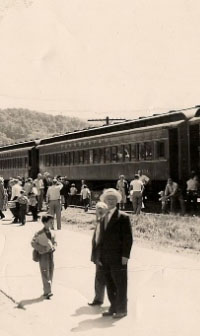
Train passengers at Alcola Park in the 1950’s